
The Thesis Trap: How to Pick a Topic That Doesn’t Kill Your Mental Health

Architecture thesis: the excitement of a big idea meets the reality of research, drawings, revisions, and deadlines.
The ultimate architecture thesis survival guide for final-year students in 2026. It starts with a feeling of grand design. You are sitting in a café in Gulberg, scrolling through Pinterest and ArchDaily. Maybe you are hiding in the back of your university library, staring at an award-winning architecture project that looks like something from the year 2050. Suddenly, inspiration strikes.
“This is it. This is the project that will define me as an architect.”
You decide to design a floating city for climate refugees. Or a futuristic sustainable skyscraper that generates its own energy. Maybe a massive NGO complex that solves homelessness, animal welfare, and urban poverty—all under one spectacular roof. You can already imagine the final render. The dramatic façade. The beautiful presentation boards. Your professors nodding in approval. Your project getting featured on architecture platforms. You feel like a visionary.
Fast-forward six months.
It’s 4 AM. Your Rhino model has crashed. Your Revit file is taking forever to open. Your research folder contains 150 PDFs, but your floor plans are still incomplete. You have created fifteen beautiful AI-generated concepts, but you can’t explain how the building’s structure actually works. Your supervisor wants detailed sections. Your jury is approaching. You haven’t been sleeping properly, and the project you once loved has become the thing you dread opening every morning.
Welcome to The Thesis Trap.
The biggest mistake architecture students make isn’t always a bad floor plan, an ugly render, or poor presentation skills. Sometimes, it happens months before the first drawing.
It happens when you choose a topic so ambitious that it eventually becomes impossible to manage.
And in 2026, with AI design tools, endless social media inspiration, climate challenges, and the pressure to create an extraordinary portfolio, falling into this trap has become easier than ever. At ZARCH Studios, we believe your final-year architecture thesis should challenge your imagination, strengthen your technical abilities, and help you grow as a designer. It shouldn’t require you to sacrifice your health to prove your creativity.
Here’s how to avoid the Thesis Trap.
1. The “Save the World” Delusion
Let’s start with the most tempting mistake. Architecture students love big ideas. A housing solution for everyone. A city that eliminates pollution. A rehabilitation centre that solves multiple social problems. An entire urban development designed to fight climate change. These are meaningful subjects. But here’s the problem:
You’re an architecture student, not an entire government planning department.
When you choose a topic that’s too broad, you risk spending months researching economics, politics, sociology, technology, and public policy without establishing a focused architectural investigation. Your thesis might become an impressive research document.
- But where is the building?
- Where is the spatial experience?
- Where are the sections, structure, circulation, daylight, accessibility, and construction logic?
A strong architecture thesis needs more than a compelling social mission. It needs an architectural response.
The Fix: Think Smaller, Design Deeper
Instead of: Solving Homelessness in Pakistan Through Architecture
Try: A Transitional Housing Prototype for Low-Income Families in Lahore.
Instead of: A Sustainable City to Fight Global Climate Change
Try: Passive Cooling Strategies for a Community Learning Centre in Lahore.
See the difference? The second versions don’t abandon the larger problems. They create a specific opportunity to investigate them through architecture. Now you can develop real spatial solutions, study the site, test environmental strategies, and resolve building details.
A smaller project doesn’t automatically mean a smaller architectural impact.
Sometimes, the most meaningful architecture comes from addressing one carefully defined problem exceptionally well.
Architectural Response VISUAL 2 — THESIS SPECIFICITY FUNNEL: Global Problem → Local Challenge →
2. Your Site Is Your Best Friend or Your Worst Enemy
Imagine presenting your beautiful thesis project to a jury. Your renders are stunning. Your building looks futuristic. Your presentation boards look professionally designed. Then a juror asks: “Why did you choose this site?” And your answer is: “Because the plot was big enough for my building.” That’s a problem. A site isn’t just an empty piece of land waiting for your architectural masterpiece. It’s a collection of environmental, cultural, physical, and social conditions that should influence what you design.
Lahore Is Already Full of Architectural Questions
Take the Walled City of Lahore. Its narrow streets, historic urban fabric, courtyards, cultural identity, mixed-use activities, and layered architectural heritage offer countless opportunities for investigation. You can study how people occupy space, how older buildings respond to climate, how public and private activities overlap, and how existing architecture can be adapted for contemporary needs.
Or consider another part of Lahore where urban heat, drainage, pedestrian access, or a shortage of public facilities creates a real design challenge. These conditions can become the foundation of your thesis. Compare that with choosing a random empty site and forcing a preconceived architectural concept onto it. You end up inventing reasons why your building should exist there.
The Fix: Let the Site Influence Your Topic
Before finalizing your architecture thesis site, ask yourself:
- Can I visit it or obtain reliable site documentation?
- What specific architectural problem exists here?
- Who will use the proposed building?
- How do sunlight, wind, noise, access, drainage, and surrounding buildings affect the project?
- What legal, cultural, structural, or environmental constraints might influence the design?
Visit the site when possible. Photograph it. Sketch it. Observe how people move. Study building heights, road connections, and existing conditions. If physical access is not possible, use credible maps, surveys, published research, and other verifiable documentation. And please, don’t confuse site analysis with adding colorful arrows to a Google Maps screenshot.
Your design should respond to the site—not look like an architectural spaceship that accidentally landed there.
3. The Research Black Hole
Architecture students have a special relationship with research.
- We love collecting information.
- We download journal papers, make case-study folders, organize Pinterest boards, and prepare beautiful analytical diagrams.
- We research the history of the city.
- The evolution of building typologies.
- The psychology of architecture.
- The sociology of urban life.
- Everything.
- Except the actual building we’re supposed to design.
- Three months later, our research report looks impressive.
- But our floor plan?
- Still a collection of rough lines.
- Then comes the panic.
The final jury is approaching, and suddenly we’re trying to design an entire building in a few weeks.
The Fix: Research and Design Should Happen Together
Research isn’t something you finish before architecture begins. It’s something that continuously informs your decisions. Think of your thesis process as a loop:
Research → Sketch → Test → Evaluate → Improve
- Return to the research.
- Improve the proposal.
- Your early sketches don’t need to be beautiful.
- Your first 3D model doesn’t need to look like an international architecture competition entry.
- It simply needs to help you think.
The purpose of your first design isn’t to impress anyone. It’s to discover what doesn’t work yet.
4. The AI Trap: When Your Render Is Smarter Than Your Building
Now let’s talk about something that has completely changed the architecture-school experience. Artificial intelligence. In 2026, AI is becoming increasingly common in architectural workflows. According to the Royal Institute of British Architects’ 2026 AI Report, 74% of surveyed UK architecture practices reported using AI in at least some projects. Meanwhile, the 2026 UNESCO–UIA Charter for Architectural Education emphasizes that AI should complement architectural design thinking rather than replace it.
And that’s exactly where students need to be careful. Today, you can generate an incredible architectural concept before you’ve even selected a site. A few prompts can produce a spectacular biomorphic building with dramatic cantilevers, landscaped terraces, and cinematic lighting. It looks extraordinary. But your jury isn’t evaluating an image-generation competition. They are evaluating architectural thinking.
The Problem With AI-Generated Concepts
Ask yourself:
- Where are the stairs?
- Do the floor levels connect?
- How is the building supported?
- Can people actually move through the spaces?
- Are the environmental strategies genuine or just visual decoration?
- Does the design accommodate accessibility, safety, services, and construction requirements?
If you cannot answer these questions, your architectural design needs more work—regardless of how beautiful the render looks.
The Fix: Make AI Your Assistant, Not Your Designer
Use AI to explore ideas, organize research questions, understand unfamiliar concepts, and test visual directions.
- But verify its facts and references.
- Don’t assume an AI-generated technical detail is correct.
- Don’t let an attractive image override your site, program, or spatial logic.
- Follow your university’s rules concerning AI use and academic integrity.
- Most importantly, make sure you can explain and defend every important design decision yourself.
AI can help you visualize architecture faster. It cannot automatically give you the architectural judgment needed to make that design work.
5. The Software Over-Reliance Trap
Every architecture student knows someone who spends more time experimenting with software than designing. Maybe that person is you. You see an incredible parametric building on ArchDaily. Now you need Grasshopper. You discover a new rendering engine. Now your thesis needs that too. Then comes a complex environmental simulation plugin. Then an AI workflow. Then another plugin. Suddenly, you’ve spent three weeks learning tools instead of developing your project.
The Fix: Use the Tools That Serve Your Design
- If SketchUp helps you produce quick massing studies, use it.
- If AutoCAD helps you develop accurate technical drawings, use it.
- If Revit is appropriate for your building documentation, use it.
- If Rhino and Grasshopper are genuinely necessary for your design investigation, learn what you need.
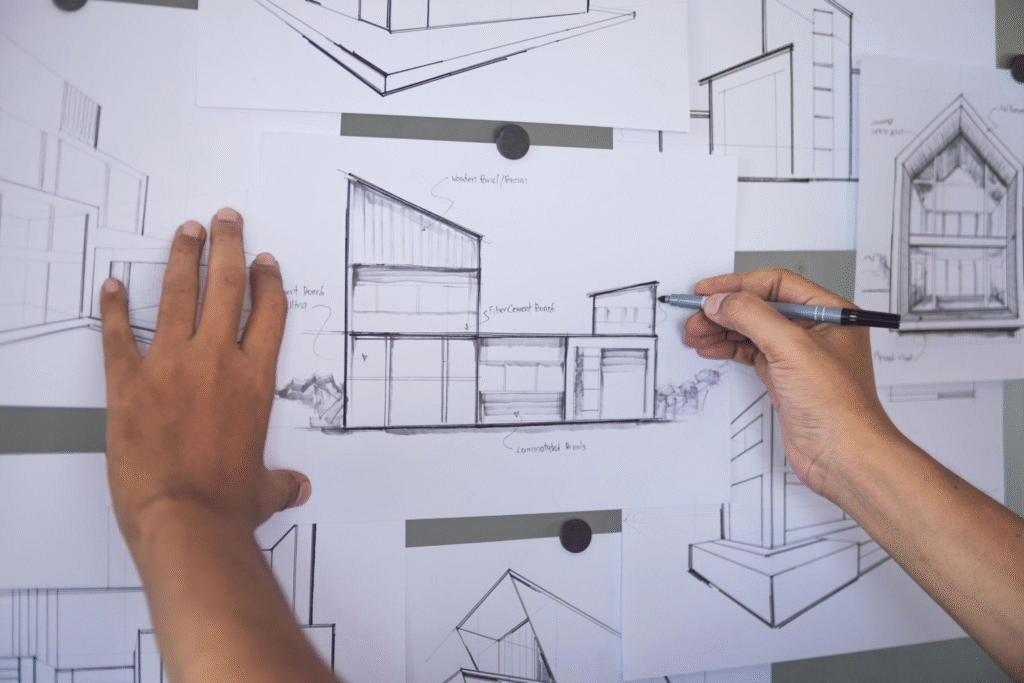
But don’t make software complexity the measure of architectural quality. A carefully developed building with logical circulation, meaningful spatial experiences, and properly resolved sections can be far stronger than a complicated form with no clear structure. And don’t abandon hand sketches. Sometimes, one thoughtful section drawn with a pencil explains more about a building than ten cinematic renders.
Your thesis should demonstrate your ability to think like an architect—not your ability to collect software certificates.
6. Your Final Jury Is a Storytelling Exercise
Here’s something students often realize very late:
A good design and a good presentation are two different skills.
You can have an intelligent, beautifully resolved project. But if your presentation consists of thirty overcrowded boards, microscopic text, confusing diagrams, and endless explanations, your jurors may struggle to understand it. Your job isn’t just to create architecture. It’s also to communicate the architectural argument behind it.
The Five-Second Test
Imagine someone looking at your presentation board from a couple of metres away.
- Within five seconds, can they identify the main idea?
- Can they understand which drawing matters most?
- Can they immediately recognize the project’s architectural character?
This isn’t an official judging rule. It’s a useful graphic-design test. A clear visual hierarchy encourages the viewer to explore your project rather than struggle through it.
The Fix: Give Your Presentation a Structure
Your boards should communicate a logical sequence:
The Problem: What are you investigating?
The Context: Why does the site matter?
The Research: What evidence informs your proposal?
The Concept: What architectural strategy are you developing?
The Building: How do the plans, sections, circulation, structure, materials, and environmental systems work?
The Outcome: What does your proposal contribute?
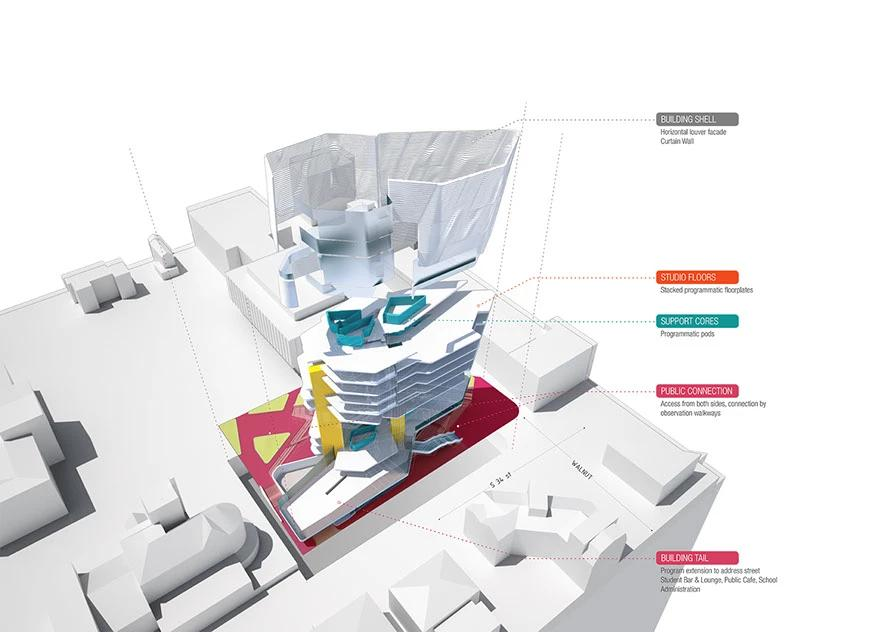
Use one powerful architectural drawing as a visual anchor. It could be an exploded axonometric, a building section, an environmental diagram, or a carefully composed architectural visualization. But don’t let the hero image overpower your technical drawings. And practice your explanation before the jury. A student who can calmly explain a project’s strengths, limitations, and design decisions often communicates more effectively than someone relying entirely on dramatic visuals.
Your jury doesn’t need to hear how revolutionary your building is. They need to understand why you designed it the way you did.
7. Burnout Is Not a Requirement for Becoming an Architect
Let’s address the part of architecture school that rarely appears in beautiful portfolios.
Exhaustion. Architecture students often treat all-nighters like badges of honor. Someone hasn’t slept in two days. Someone else has been living in the studio. Another student has survived on coffee and takeaway food all week. We laugh about these things. But constant exhaustion should not be romanticized as an essential part of architectural education. A 2025 study of academic workload and burnout among architecture students examined how workload and the learning environment contribute to student fatigue and burnout. Its findings are based on a specific student sample, but they highlight genuine concerns about architectural education. And here’s an important distinction:
A demanding thesis can be rewarding. A consistently unhealthy working routine is not something you should have to accept.
The Fix: Manage Your Project Like an Architect
Professional projects require planning, priorities, coordination, and realistic deadlines. Your thesis is a good opportunity to practice those skills. Set weekly milestones.Create a list of essential drawings and research deliverables. Separate necessary work from optional presentation improvements. Allow time for revisions and unexpected problems. Keep regular contact with your supervisor. And make sleep, meals, movement, and breaks part of your schedule rather than treating them as rewards you only deserve after finishing everything.
If academic pressure becomes overwhelming, reach out to someone you trust, your supervisor, student-support services, or a qualified mental-health professional. Choosing a manageable topic can reduce unnecessary pressure, but burnout also depends on workloads, institutional expectations, personal circumstances, and access to support. Being exhausted doesn’t make your design more intelligent.
8. How to Choose the Right Architecture Thesis Topic in 2026
Now that you know the traps, let’s get practical. Before finalizing a thesis topic, put it through these five questions.
1. Am I Genuinely Interested in This Subject?
You’ll spend months investigating it. Don’t select something simply because it sounds impressive to your friends.
2. Does It Have Real Architectural Depth?
Can you develop meaningful plans, sections, spatial experiences, environmental strategies, and technical resolutions?
3. Can I Access the Required Information?
Do you have reliable site information, relevant references, and a realistic way to investigate the project?
4. Can I Complete It Within My Academic Timeline?
Consider your actual available time, technical skills, university requirements, and submission deadlines.
5. Can I Explain Why This Project Matters?
You should be able to describe your thesis in a few clear sentences without relying on fashionable architectural terminology.
If your topic fails several of these questions, it doesn’t necessarily mean the idea is bad. It may simply need to be refined.
Six Architecture Thesis Ideas Worth Investigating
If you’re still searching for a direction, consider these possibilities:
| Thesis Direction | Architectural Focus |
| Climate-Responsive Community Learning Centre | Passive cooling, daylight, shading, and public space |
| Adaptive Reuse of a Historic Urban Building | Heritage, material conservation, and contemporary functions |
| Transitional Housing Prototype | Affordability, modularity, privacy, and shared spaces |
| Flood-Resilient Community Facility | Site planning, safe access, drainage, and adaptive design |
| Urban Heat Relief Centre | Thermal comfort, public health, and climate-responsive architecture |
| Inclusive Public Library | Universal accessibility, learning spaces, acoustics, and daylight |
These are possible research directions, not guaranteed thesis approvals. A successful project still requires a clearly defined architectural question, appropriate site, credible methodology, and compliance with your university’s expectations.
9. The First 14 Days: Stop Overthinking and Start Designing
One of the easiest ways to avoid the Thesis Trap is to establish momentum early. You don’t need the perfect building in your first two weeks. You need a direction.
Days 1–3: Identify Your Interests
Write down three architectural issues you genuinely care about.
Days 4–5: Narrow the Scope
Turn each broad issue into a possible building typology, user group, and research question.
Days 6–8: Explore Potential Sites
Investigate the location, context, access, climate, and available information.
Days 9–11: Study Relevant Precedents
Explore a few meaningful architectural case studies. Understand the design logic rather than simply collecting attractive images.
Days 12–14: Begin Designing
Sketch ideas. Make rough massing models. Explore spatial relationships. Discuss your direction with your supervisor. Adjust this schedule to your university’s academic requirements. The objective is not to rush research.
It’s to avoid remaining stuck in endless topic selection while the rest of the semester disappears.
You don’t need a perfect thesis topic to begin thinking architecturally. You need a focused question worth investigating.
Frequently Asked Questions
What is the best architecture thesis topic in 2026?
There is no universally best topic. A strong thesis addresses a clearly defined architectural problem, offers meaningful design opportunities, and can be researched and developed within the student’s academic timeline.
How do I choose an architecture thesis topic in Pakistan?
Begin with a relevant social, spatial, environmental, or cultural challenge. Investigate a potential site, identify a suitable building typology and user group, and establish a research question that can be explored through architectural design.
Can I use ChatGPT and AI image generators for my architecture thesis?
AI can support research organization, brainstorming, concept exploration, and visualization. However, technical information must be verified, and all use should follow your university’s academic-integrity and disclosure requirements.
Can a small building be a strong final-year architecture thesis?
Yes, if it provides enough architectural and academic depth. Building size alone does not determine thesis quality. However, your selected scope must meet your university’s project requirements.
How can I avoid architecture thesis burnout?
Choose a manageable project scope, establish realistic milestones, begin sketching early, get regular feedback, avoid unnecessary scope changes, and protect your health throughout the semester.
What should I present in my final architecture jury?
The exact requirements depend on your university, but typical deliverables include the research question, site analysis, concept development, architectural plans, elevations, sections, relevant technical drawings, visualizations, and a clear explanation of your design decisions.
Conclusion: Your Thesis Is Not Your Entire Life’s Work
Here’s the most important thing I want you to remember. Your thesis is a project. It’s not the last thing you’ll ever design. It’s not the peak of your architectural career. And it’s certainly not the final measurement of your intelligence, creativity, or potential. It’s a bridge between learning architecture and beginning to practice it. So yes, choose something that excites you. Design that NGO you’ve been thinking about.
Explore that sustainable high-rise. Investigate the social or environmental problem that genuinely matters to you. But keep it grounded. Make sure your building has a purpose. Make sure the stairs align. Make sure the structure makes sense. Make sure people can actually use the spaces you’ve created. And remember that even the most ambitious concept becomes stronger when it is supported by thoughtful architectural decisions. You don’t need to design a building that solves every problem in the world. You need to demonstrate that you understand one meaningful architectural problem and can investigate it with curiosity, creativity, and technical responsibility
Stop trying to prove you’re a genius. Start becoming a thoughtful architect.
The best architecture you will ever create might still be years ahead of you. Good luck with your thesis. Get some sleep. And go draw something.
ZARCH Studios Academy — Learn, Design, Create
At ZARCH Studios, we believe architectural education should encourage creativity, independent thinking, and practical design knowledge.
Through ZARCH Studios Academy, our aim is to share architectural case studies, thesis guidance, AI design resources, and professional insights that help students turn ambitious ideas into meaningful architecture. Your turn: What’s the biggest challenge you’re facing in your architecture thesis—choosing a topic, selecting a site, developing the concept, or preparing for your final jury? Share your experience in the comments. Your question might inspire our next Academy article.